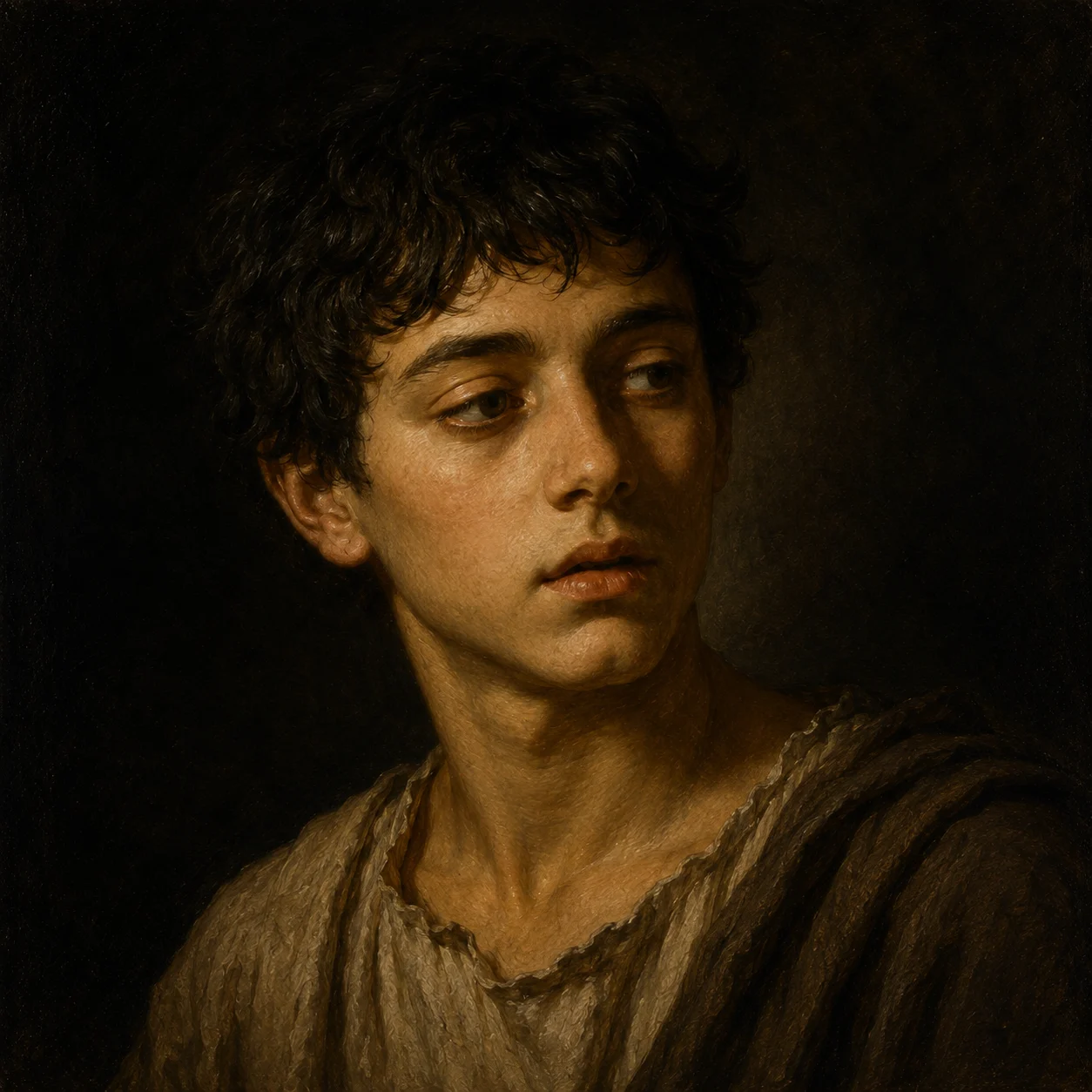
Lucius
Lucius functions as the domestic register of Brutus's private life - the presence that makes Brutus's scenes in his house and tent feel inhabited rather than merely staged. His falling asleep on the night of the ghost is a structural contrast: the servant who should be keeping watch is lost in innocent sleep while his master confronts something far beyond ordinary vigilance.
Appears In
Who is Lucius?
Lucius is Brutus's servant boy, and he appears at moments of private domestic intimacy that the play's public scenes never reach. He is sent to find a candle and a letter; he is told to knock at a gate in the night; he runs errands between Brutus and Portia. He obeys without question and without apparent awareness of the weight of what surrounds him, which is precisely what makes him useful to the play - he is the one character in Brutus's orbit who is simply present rather than freighted with significance.
His most extended scene is in Act IV, where Brutus asks him to play on his lute while the camp sleeps. Lucius plays, falls asleep mid-tune, and sleeps through the appearance of Caesar's ghost. When Brutus wakes him - shaken, needing the simple confirmation that another person is present - Lucius mumbles that he will play again and drops back into sleep. The exchange is among the play's most quietly devastating: Brutus, alone with something he cannot explain, unable to wake even his servant.
Brutus's treatment of Lucius is notably gentle. He tells him not to apologise for falling asleep, covers him carefully, takes the instrument out of his hands so he will not break it. In a play full of men who regard other men as instruments, Brutus's care for his servant boy is one of the few unambiguous expressions of simple human tenderness that the character permits himself.
Motivation
Lucius is motivated by straightforward service to Brutus - he does what he is asked, without evident understanding of the political catastrophe unfolding around him. His youth and his sleep are the qualities the play needs him to have.
Personality
Lucius is characterised almost entirely by his smallness relative to the world around him - he is a boy in a play of world-historical events, and the gap between his sleepy domestic service and the violence and ruin surrounding it is one of the quietest sources of pathos in Julius Caesar.