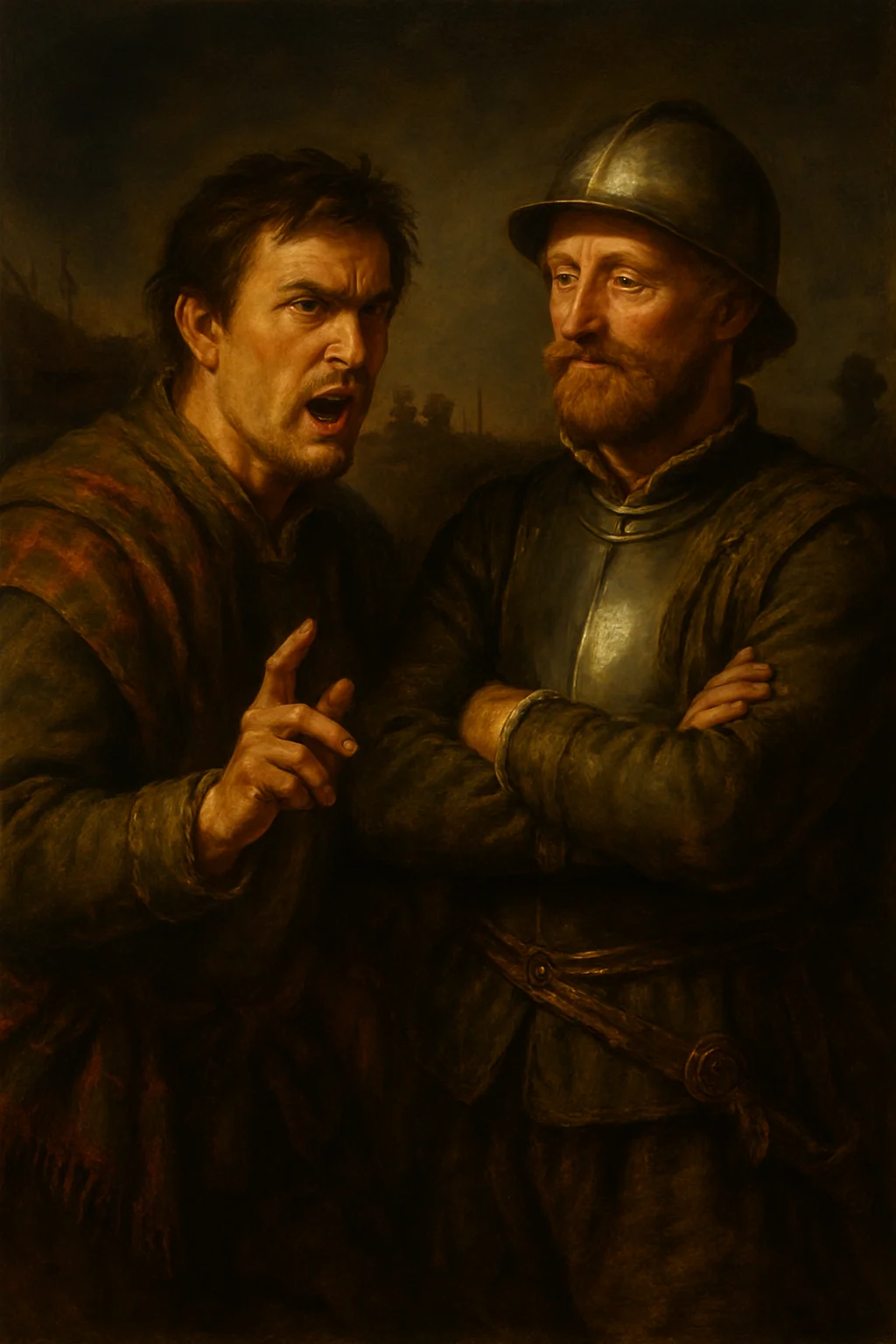
Macmorris & Jamy
Macmorris and Jamy complete the play's famous four-captains scene, their Irish and Scottish voices alongside Fluellen's Welsh and Gower's English exposing the real tensions beneath the unified British army Henry's rhetoric otherwise presents as seamless.
Appears In
Who are Macmorris & Jamy?
Macmorris and Jamy are, respectively, an Irish and a Scottish captain serving in Henry's army, and their appearance alongside the Welsh Fluellen and the English Gower during the siege of Harfleur produces one of the play's most pointed pieces of political texture - the four captains, each speaking in a distinct national idiom, standing in for the uneasy union of the British Isles under a single English crown. The scene is played largely for comedy, but the tensions it surfaces are real.
Macmorris is quick-tempered and defensive, taking sharp offense when Fluellen's comment about 'the disciplines of the war' is heard, or misheard, as a slight against the Irish nation specifically, and his heated response - demanding to know what is meant by 'my nation' - very nearly escalates into a real quarrel before the moment passes. Jamy, by contrast, is eager and even-tempered, a dry, martial presence content to let the argument between Fluellen and Macmorris play out around him while offering his own soldierly assessment when asked.
Neither man reappears once the siege scene concludes, their brief exchange having done its work: a comic set-piece that also quietly acknowledges how much national friction the king's unifying rhetoric is working to paper over.
Motivation
Macmorris is motivated by fierce national pride and a low tolerance for any perceived slight against his countrymen; Jamy is motivated by straightforward professional soldiering and an even-tempered willingness to let disputes resolve themselves.
Personality
Macmorris's temper flares instantly at any hint of national insult, a defensiveness that reveals how precarious the alliance between England's constituent nations actually is beneath the surface of shared purpose. Jamy's calm, dry professionalism provides the necessary counterweight, a soldier content to do his duty without needing his nation's honour personally vindicated at every turn.