Erpingham
Erpingham provides the play's warmest small moment on the eve of Agincourt, and his borrowed cloak becomes, without his knowledge, the very disguise Henry uses for the play's most reflective and vulnerable scene.
Appears In
Who is Erpingham?
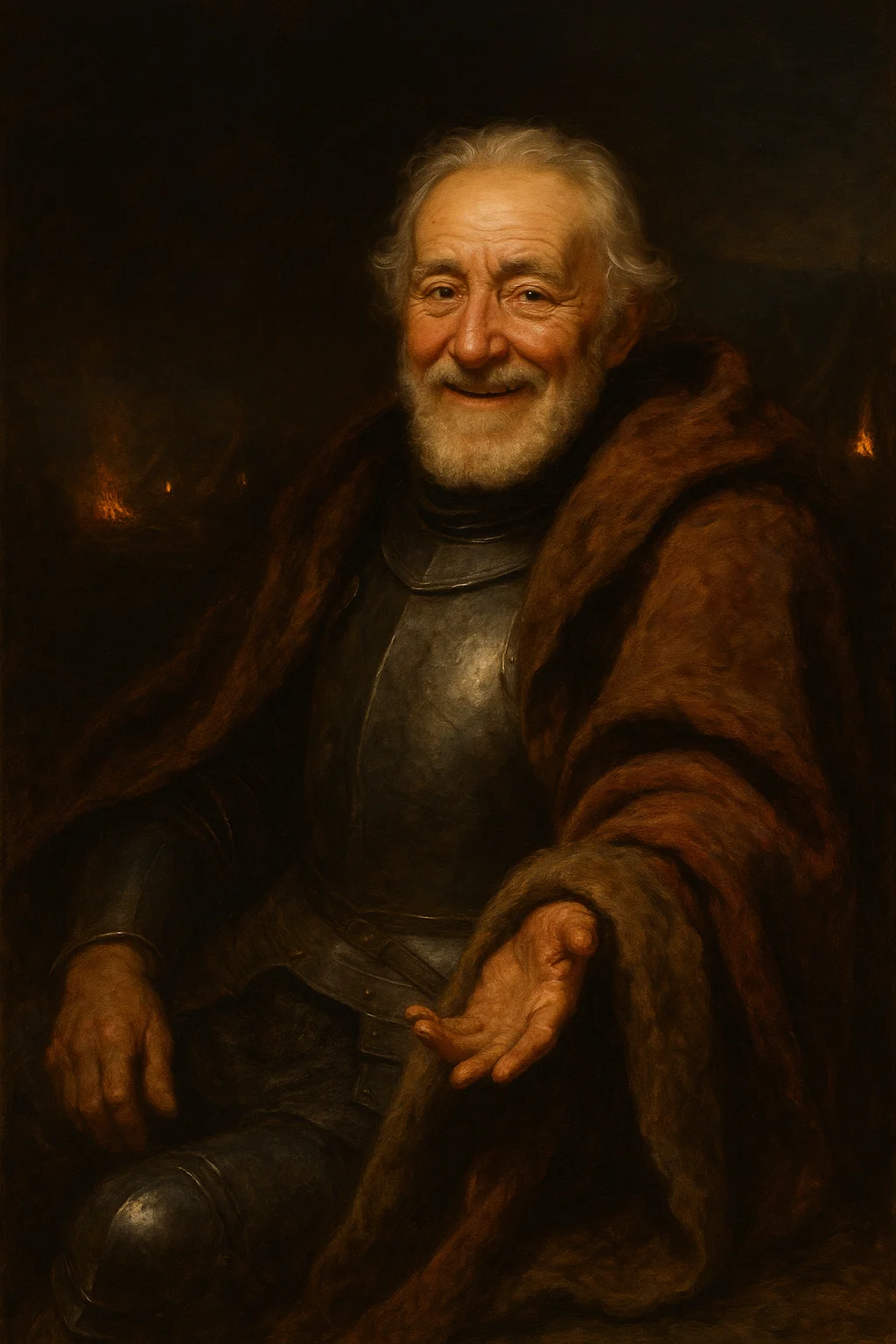
Erpingham is an old knight in Henry's camp the night before Agincourt, introduced in a brief, warm exchange that gives the play one of its gentlest small moments amid the tension before battle. Henry finds him settling in for what rest the cold ground affords and remarks on his age and the discomfort of a soldier's bed; Erpingham answers with cheerful, unforced contentment - 'this lodging likes me better, / Since I may say, "Now lie I like a king."' - a small joke that Henry, about to borrow his cloak and identity for a night of disguise, receives with visible affection.
It is Erpingham's cloak that Henry borrows to walk unrecognized among his common soldiers that night, a detail that makes Erpingham, unknowingly, the instrument of the king's most searching and vulnerable scene in the play. Erpingham himself is unaware of the use his garment will be put to, his brief warmth toward the king offered without any expectation of what it enables.
He does not reappear once the battle is joined, his function - providing a moment of old soldierly good cheer and the literal means of Henry's disguise - complete in this single scene.
Motivation
Erpingham is motivated by simple loyal cheerfulness - an old soldier's contentment with hardship, offered to his king without any calculation or expectation of significance.
Personality
Erpingham's brief scene reveals a man whose age has not dimmed his good humour or his loyalty - he meets the discomfort of a soldier's night in the field with genuine contentment, a small, warm counterpoint to the anxious, searching mood that follows once Henry borrows his cloak and walks alone among the ranks.