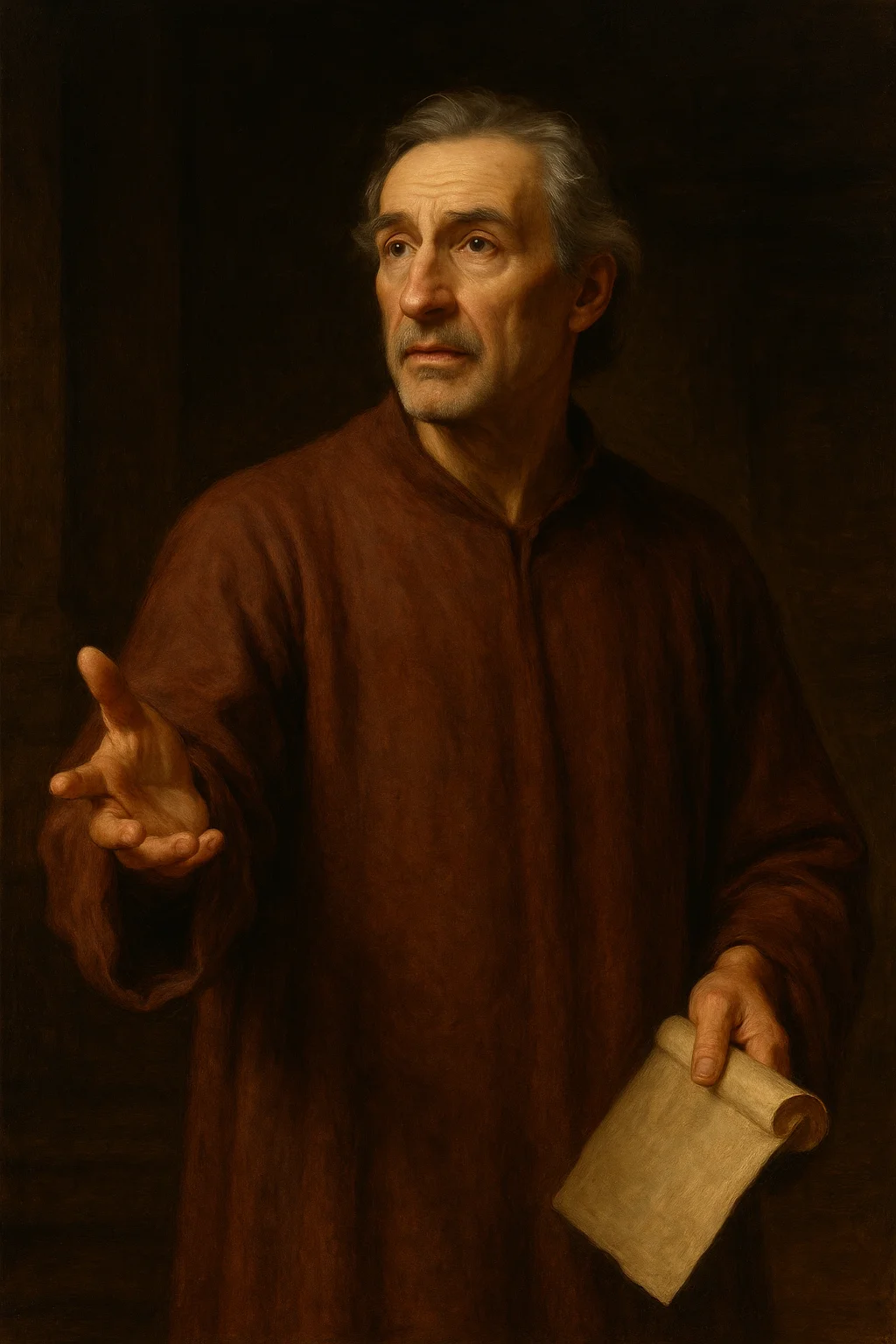
Chorus
The Chorus functions as the play's narrator, master of ceremonies, and conscience about its own theatrical limits - building Henry into a figure of near-mythic stature act by act, while its final Epilogue quietly complicates the legend it has spent the whole play constructing.
Appears In
Who is Chorus?
The Chorus opens the play by apologizing for the play itself - for the impossibility of fitting 'the vasty fields of France' onto a wooden stage crowded with a handful of actors, 'four or five most vile and ragged foils, / Right ill-disposed in brawl ridiculous,' standing in for the clash of armies at Agincourt. It is an unusual admission for a Shakespearean prologue to make, and it sets the terms for everything that follows: the audience is asked, repeatedly and explicitly, to do imaginative work the theatre cannot do for them - to see 'a kingdom for a stage, princes to act, / And monarchs to behold the swelling scene.'
Between each act, the Chorus returns to bridge what the stage cannot show directly - the fleet crossing the Channel, the long approach march to Agincourt, the night before the battle with its watch-fires burning across two camps. Its language is the most soaring in the play, deliberately so; the Chorus is in the business of building Henry into legend, painting him as 'the mirror of all Christian kings' and the English cause as something closer to destiny than to a contested dynastic claim.
That mythmaking is not left unquestioned. In the Epilogue, the Chorus steps back from the triumph it has spent five acts constructing and reminds the audience, in a handful of plain lines, that Henry's infant son inherited France and 'lost it, and made his England bleed' - a deflating coda that quietly undercuts the certainty of everything the Chorus has just persuaded the audience to feel. Whether the play endorses its own patriotic architecture or dismantles it in that final breath is a question the Chorus leaves open.
Motivation
The Chorus is motivated by the wish to make the audience complicit in the play's own act of imagination - its repeated appeals to 'piece out our imperfections with your thoughts' are not mere modesty but an argument that the grandeur of Agincourt can only ever exist in the space between the stage and the mind watching it.
Personality
The Chorus speaks in the play's most elevated register, reaching for images of fire and flood and 'the game of war' to compensate for what the stage cannot literally provide. Its self-awareness about the gap between spectacle and stagecraft gives it an unusual double quality - sincere in its patriotism, yet frank about the artifice required to produce that feeling, and willing, in its final lines, to let the audience's certainty waver.