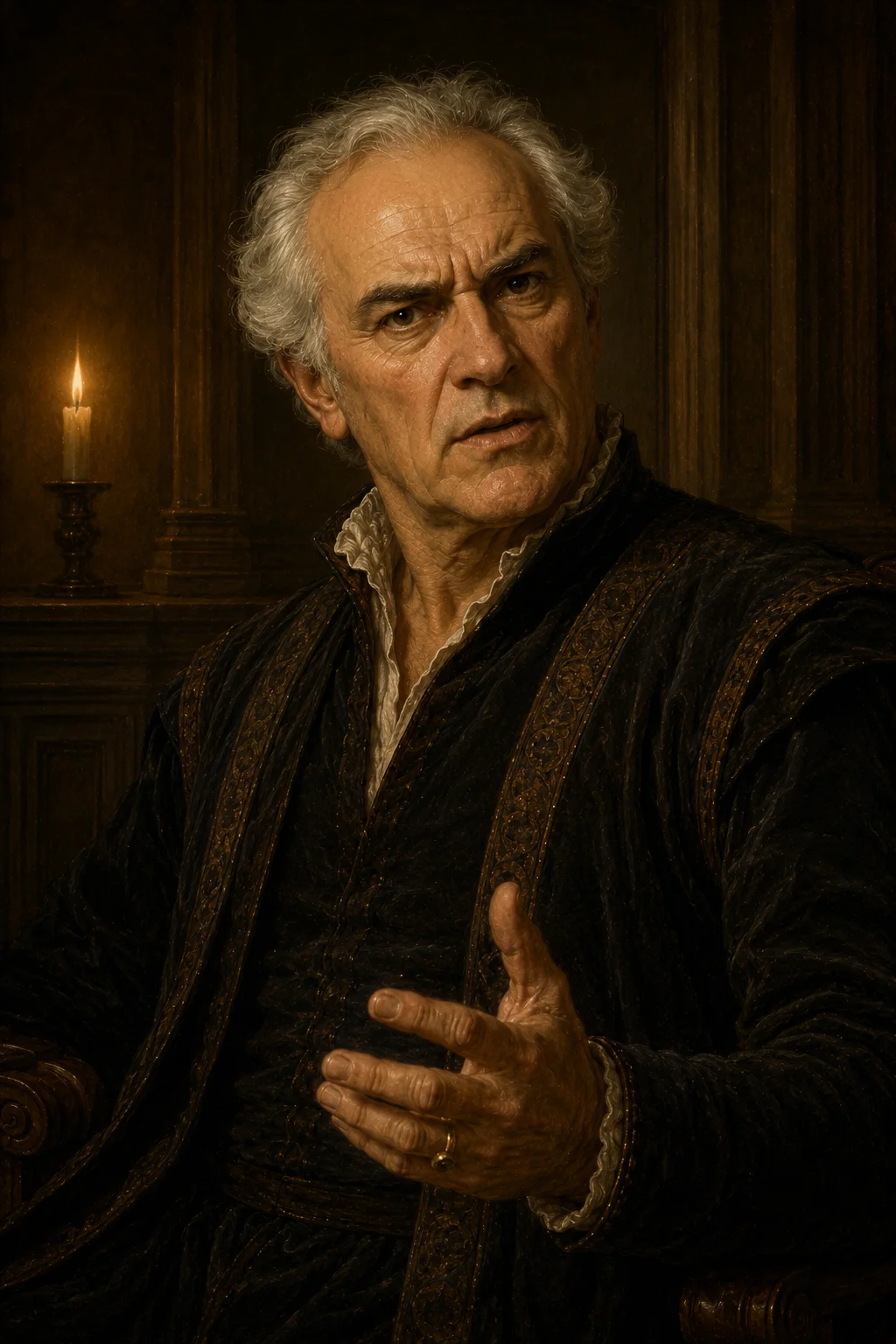
Egeus
Egeus embodies the rigidity of Athenian law and the patriarchal claim to dispose of daughters that the play systematically dismantles. He is not a villain - his complaint is legally sound - but the forest's transformations make his position increasingly irrelevant before Theseus finally sets it aside.
Appears In
Who is Egeus?
Egeus is Hermia's father, the play's first embodiment of Athenian patriarchal law and the figure whose grievance before Theseus sets every subsequent event in motion. He invokes the full weight of Athenian legal authority against his daughter's romantic preference with complete conviction - his complaint is not presented as malicious but as the sincere expression of a man who believes he is entirely within his rights, which he is.
His insistence that Lysander has 'bewitched' Hermia with love tokens and moonlight serenades is the play's first invocation of magic in its pejorative sense - as manipulation, as something done to a young woman against her better judgement rather than with it. The irony is that actual enchantment follows shortly in the forest, and Egeus appears to notice no difference between the two.
He reappears in Act IV to discover the lovers asleep together and to renew his objections to the Lysander-Hermia match, only to be overridden by Theseus with cheerful finality. He has no response to this. His authority, so absolute in Act I, is entirely dependent on the Duke's willingness to sustain it - and once Theseus decides otherwise, it evaporates without remainder.
Motivation
Egeus is motivated by a genuine belief in his parental authority and a specific preference for Demetrius as his son-in-law that the play never explains and never needs to. His conviction is entirely self-reinforcing: he is right because Athenian law says he is right, and the law is right because it says so.
Personality
Egeus is the play's most purely functional blocking figure - he exists to create the obstacle that sends the lovers into the forest, and to be set aside once the forest has done its work. He is not developed beyond this function, but within it he is drawn with enough conviction that his Act I complaint feels less like a plot mechanism than a genuine expression of a particular kind of paternal certainty that mistakes control for care.