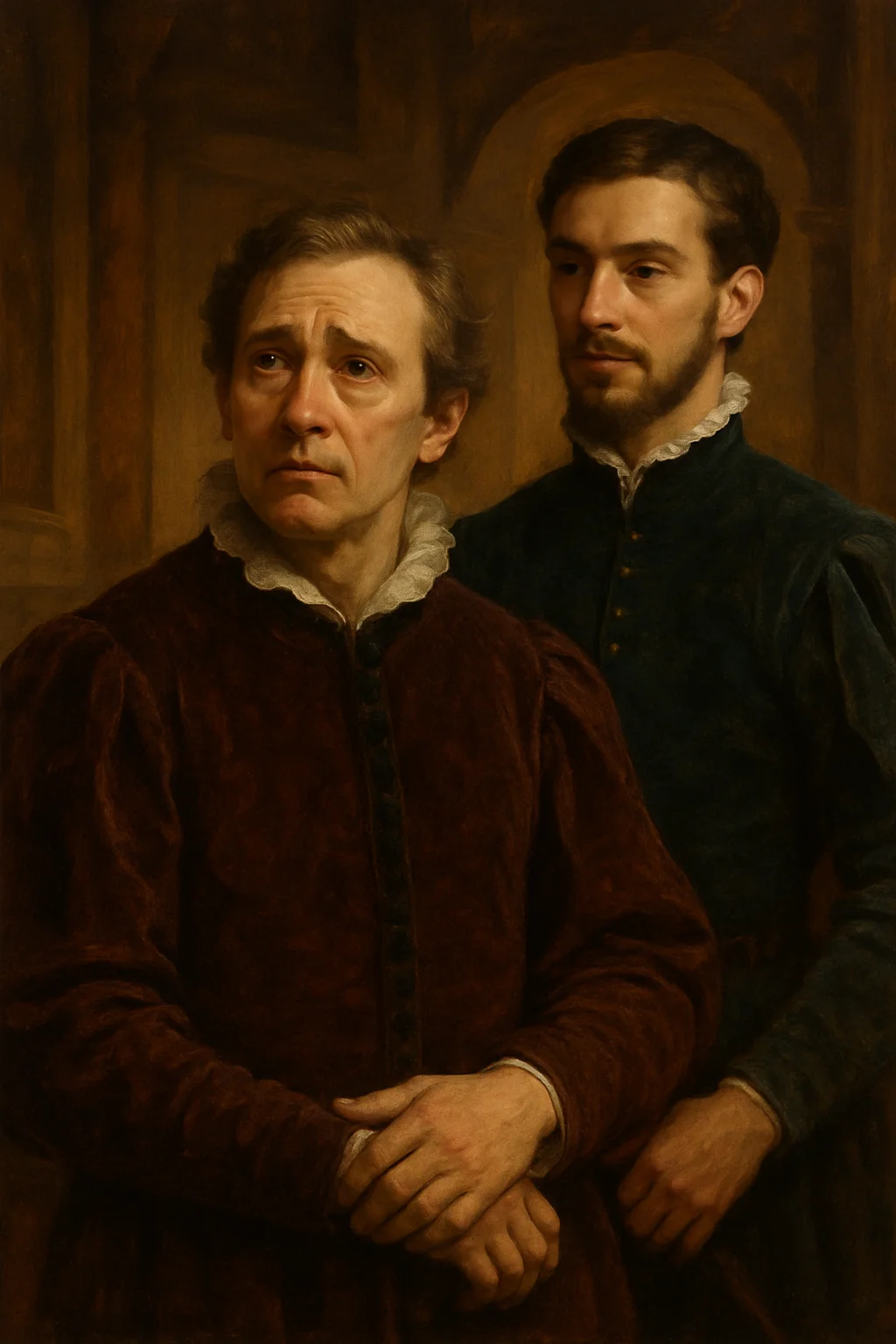
Curio & Valentine
Curio and Valentine are Orsino's loyal attendants whose brief contributions — Valentine's report on Olivia, Curio's small distraction attempts — establish the court's atmosphere of romantic fixation without adding to its substance.
Appears In
Biography
Curio and Valentine are gentlemen of Orsino's court, present in the Duke's scenes as the background of a love-sick court doing its best to service its master's romantic obsessions. Valentine has the more distinct role — he is sent to court Olivia on Orsino's behalf in Act I and returns with her refusal, delivered with enough detail about her mourning to make Orsino more enraptured rather than less. His report establishes the situation and then Valentine largely disappears from the action.
Curio's most memorable contribution is an attempt to distract Orsino in Act I, Scene 1 — 'Will you go hunt, my lord?' — which Orsino deflects with a pun on 'hart' and 'heart' that says more about his state of mind than any distraction could address. Curio is present again in Act II, Scene 4, where he fetches Feste to sing 'Come away, death' for Orsino's melancholy pleasure. Both gentlemen are defined by attendance rather than initiative — they witness the Duke's romantic posturing without commentary and serve as the furniture of his court.
Together they represent the ordinary texture of a court organised around a melancholy ruler — loyal, attentive, and somewhat at a loss for what to do with a man who wants music and then doesn't, who sends messengers to a woman who won't receive him, and who will eventually find that his real feeling was for the messenger all along.
Motivation
Both are motivated by courtly duty and genuine loyalty to Orsino, doing their best to serve a master whose romantic preoccupations leave them very little useful work to do.
Personality
Curio and Valentine are characterised almost entirely by their function — gentlemen-in-waiting who witness and occasionally facilitate without shaping events. Their quiet presence in the Duke's scenes is the ordinary background against which Orsino's extraordinary emotional intensity stands out.