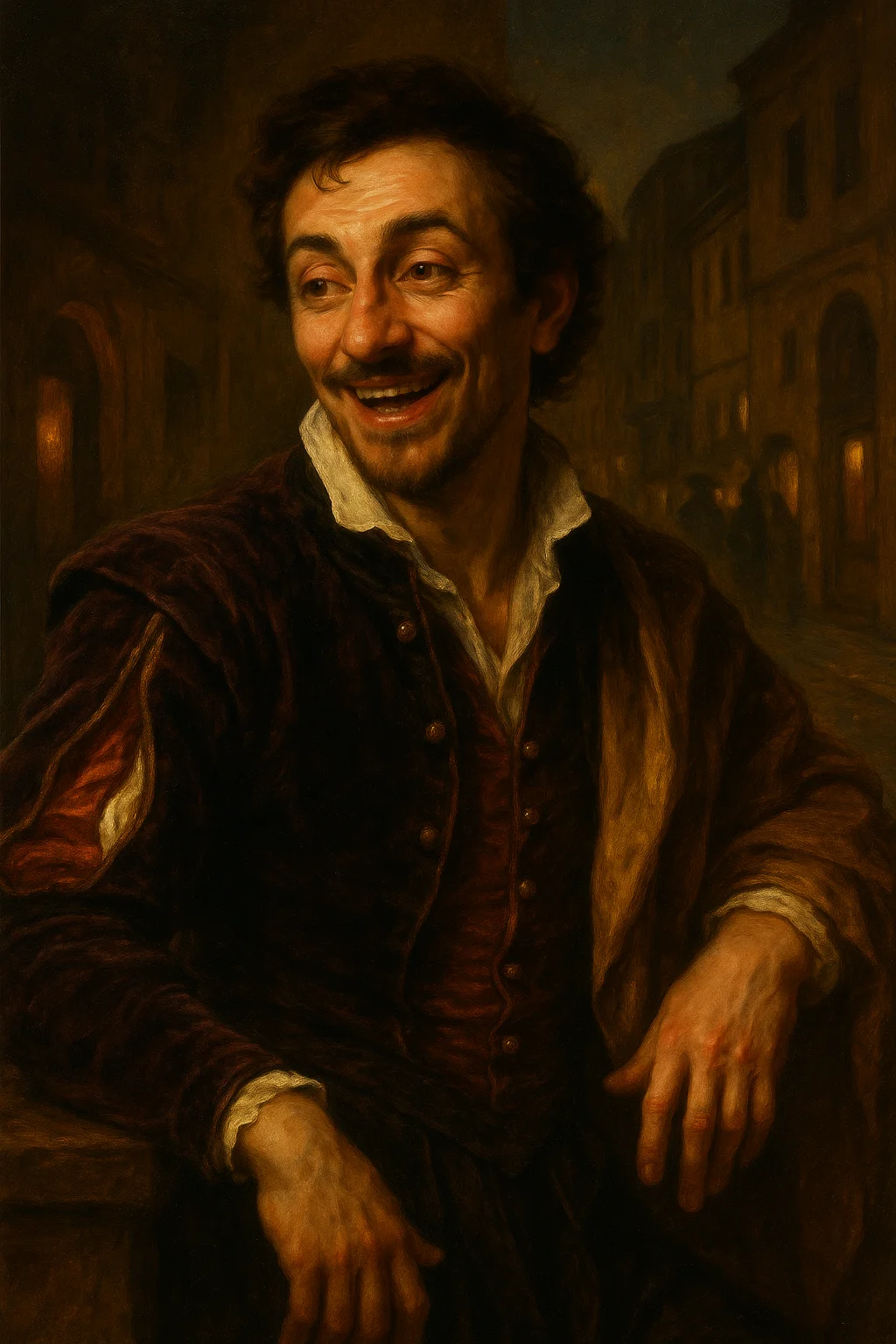
Lucio A dissolute gentleman whose loose tongue entangles him in slander against the disguised Duke.
Comedy · Measure for Measure

Lucio's lines in Measure for Measure

106 speeches in 6 scenes, with cues

37 speeches

Rehearse this scene 23 speeches
First line of the scene
Lucio
Lucio. If the duke with the other dukes come not to composition with the King of Hungary, why then all the dukes fall upon the king.
Second Gentleman Amen.
Lucio
Lucio. Thou concludest like the sanctimonious pirate, that went to sea with the Ten Commandments, but scraped one out of the table.
Second Gentleman 'Thou shalt not steal'?
Lucio
Lucio. Ay, that he razed.
Second Gentleman I never heard any soldier dislike it.
Lucio
Lucio. I believe thee; for I think thou never wast where grace was said.
First Gentleman What, in metre?
Lucio
Lucio. In any proportion or in any language.
First Gentleman I think, or in any religion.
Lucio
Lucio. Ay, why not? Grace is grace, despite of all controversy: as, for example, thou thyself art a wicked villain, despite of all grace.
First Gentleman Well, there went but a pair of shears between us.
Lucio
Lucio. I grant; as there may between the lists and the velvet. Thou art the list.
First Gentleman And thou the velvet: thou art good velvet; thou'rt a three-piled piece, I warrant thee: I had as lief be a list of an English kersey as be piled, as thou art piled, for a French velvet. Do I speak feelingly now?
Lucio
Lucio. I think thou dost; and, indeed, with most painful feeling of thy speech: I will, out of thine own confession, learn to begin thy health; but, whilst I live, forget to drink after thee.
Second Gentleman Yes, that thou hast, whether thou art tainted or free.
Lucio
Lucio. Behold, behold. where Madam Mitigation comes! I have purchased as many diseases under her roof as come to--
Second Gentleman To what, I pray?
Lucio
Lucio. Judge.
First Gentleman ...y, and more.
Lucio
Lucio. A French crown more.
First Gentleman Thou art always figuring diseases in me; but thou art full of error; I am sound.
Lucio
Lucio. Nay, not as one would say, healthy; but so sound as things that are hollow: thy bones are hollow; impiety has made a feast of thee.
Mistress Overdone Nay, but I know 'tis so: I saw him arrested, saw him carried away; and, which is more, within these three days his head to be chopped off.
Lucio
Lucio. But, after all this fooling, I would not have it so. Art thou sure of this?
Mistress Overdone I am too sure of it: and it is for getting Madam Julietta with child.
Lucio
Lucio. ...elieve me, this may be: he promised to meet me two ...ours since, and he was ever precise in promise-keeping.
First Gentleman But, most of all, agreeing with the proclamation.
Lucio
Lucio. Away! let's go learn the truth of it.
Claudio Thus can the demigod Authority Make us pay down for our offence by weight The words of heaven; on whom it will, it will; On whom it will not, so; yet still 'tis just.
Lucio
Lucio. Why, how now, Claudio! whence comes this restraint?
Claudio From too much liberty, my Lucio, liberty: As surfeit is the father of much fast, So every scope by the immoderate use Turns to restraint. Our natures do pursue, Like rats that ravin down their proper bane, A thirsty evil; and when we drink we die.
Lucio
Lucio. If could speak so wisely under an arrest, I would send for certain of my creditors: and yet, to say the truth, I had as lief have the foppery of freedom as the morality of imprisonment. What's thy offence, Claudio?
Claudio What but to speak of would offend again.
Lucio
Lucio. What, is't murder?
Claudio No.
Lucio
Lucio. Lechery?
Claudio One word, good friend. Lucio, a word with you.
Lucio
Lucio. A hundred, if they'll do you any good. Is lechery so look'd after?
Claudio But it chances The stealth of our most mutual entertainment With character too gross is writ on Juliet.
Lucio
Lucio. With child, perhaps?
Claudio And the new deputy now for the duke— Whether it be the fault and glimpse of newness, Or whether that the body public be A horse whereon the governor doth ride, Who, newly in the seat, that it may know He can command, lets it straight feel the spur; Whether the tyranny be in his place, Or in his eminence that fills it up, I stagger in:--but this new governor Awakes me all the enrolled penalties Which have, like unscour'd armour, hung by the wall So long that nineteen zodiacs have gone round And none of them been worn; and, for a name, Now puts the drowsy and neglected act Freshly on me: 'tis surely for a name.
Lucio
Lucio. I warrant it is: and thy head stands so tickle on thy shoulders that a milkmaid, if she be in love, may sigh it off. Send after the duke and appeal to him.
I have done so, but he's not to be found.
I prithee, Lucio, do me this kind service: This day my sister should the cloister enter And there receive her approbation: Acquaint her with the danger of my state: Implore her, in my voice, that she make friends To the strict deputy; bid herself assay him: I have great hope in that; for in her youth There is a prone and speechless dialect, Such as move men; beside, she hath prosperous art When she will play with reason and discourse, And well she can persuade.
I pray she may; as well for the encouragement of the like, which else would stand under grievous imposition, as for the enjoying of thy life, who I would be sorry should be thus foolishly lost at a game of tick-tack. I'll to her.
Claudio I thank you, good friend Lucio.
Lucio
Lucio. Within two hours.

Rehearse this scene 14 speeches
Isabella Yes, truly; I speak not as desiring more; But rather wishing a more strict restraint Upon the sisterhood, the votarists of Saint Clare.
Lucio
Lucio. ([Within]) Ho! Peace be in this place!
Isabella Peace and prosperity! Who is't that calls
Lucio
Lucio. Fail, virgin, if you be, as those cheek-roses Proclaim you are no less! Can you so stead me As bring me to the sight of Isabella, A novice of this place and the fair sister To her unhappy brother Claudio?
Isabella Why 'her unhappy brother'? let me ask, The rather for I now must make you know I am that Isabella and his sister.
Lucio
Lucio. Gentle and fair, your brother kindly greets you: Not to be weary with you, he's in prison.
Isabella Woe me! for what?
Lucio
Lucio. For that which, if myself might be his judge, He should receive his punishment in thanks: He hath got his friend with child.
Isabella Sir, make me not your story.
Lucio
Lucio. It is true. I would not--though 'tis my familiar sin With maids to seem the lapwing and to jest, Tongue far from heart--play with all virgins so: I hold you as a thing ensky'd and sainted. By your renouncement an immortal spirit, And to be talk'd with in sincerity, As with a saint.
Isabella You do blaspheme the good in mocking me.
Lucio
Lucio. Do not believe it. Fewness and truth, 'tis thus: Your brother and his lover have embraced: As those that feed grow full, as blossoming time That from the seedness the bare fallow brings To teeming foison, even so her plenteous womb Expresseth his full tilth and husbandry.
Isabella Some one with child by him? My cousin Juliet?
Lucio
Lucio. Is she your cousin?
Isabella Adoptedly; as school-maids change their names By vain though apt affection.
Lucio
Lucio. She it is.
Isabella O, let him marry her.
Lucio
Lucio. This is the point. The duke is very strangely gone from hence; Bore many gentlemen, myself being one, In hand and hope of action: but we do learn By those that know the very nerves of state, His givings-out were of an infinite distance From his true-meant design.
Upon his place, And with full line of his authority, Governs Lord Angelo; a man whose blood Is very snow-broth; one who never feels The wanton stings and motions of the sense, But doth rebate and blunt his natural edge With profits of the mind, study and fast.
He--to give fear to use and liberty, Which have for long run by the hideous law, As mice by lions--hath pick'd out an act, Under whose heavy sense your brother's life Falls into forfeit: he arrests him on it; And follows close the rigour of the statute, To make him an example.
All hope is gone, Unless you have the grace by your fair prayer To soften Angelo: and that's my pith of business 'Twixt you and your poor brother.
Isabella Doth he so seek his life?
Lucio
Lucio. Has censured him Already; and, as I hear, the provost hath A warrant for his execution.
Isabella Alas! what poor ability's in me To do him good?
Lucio
Lucio. Assay the power you have.
Isabella My power? Alas, I doubt--
Lucio
Lucio. Our doubts are traitors And make us lose the good we oft might win By fearing to attempt. Go to Lord Angelo, And let him learn to know, when maidens sue, Men give like gods; but when they weep and kneel, All their petitions are as freely theirs As they themselves would owe them.
Isabella I'll see what I can do.
Lucio
Lucio. But speedily.
Isabella I will about it straight; No longer staying but to give the mother Notice of my affair. I humbly thank you: Commend me to my brother: soon at night I'll send him certain word of my success.
Lucio
Lucio. I take my leave of you.

7 speeches

Rehearse this scene 7 speeches
Isabella O just but severe law! I had a brother, then. Heaven keep your honour!
Lucio
Lucio. ([Aside to ISABELLA]) Give't not o'er so: to him again, entreat him; Kneel down before him, hang upon his gown: You are too cold; if you should need a pin, You could not with more tame a tongue desire it: To him, I say!
Angelo He's sentenced; 'tis too late.
Lucio
Lucio. ([Aside to ISABELLA]) You are too cold.
Isabella I would to heaven I had your potency, And you were Isabel! should it then be thus? No; I would tell what 'twere to be a judge, And what a prisoner.
Lucio
Lucio. ([Aside to ISABELLA]) Ay, touch him; there's the vein.
Isabella To-morrow! O, that's sudden! Spare him, spare him! He's not prepared for death. Even for our kitchens We kill the fowl of season: shall we serve heaven With less respect than we do minister To our gross selves? Good, good my lord, bethink you; Who is it that hath died for this offence? There's many have committed it.
Lucio
Lucio. ([Aside to ISABELLA]) Ay, well said.
Isabella That in the captain's but a choleric word, which in the soldier is flat blasphemy.
Lucio
Lucio. ([Aside to ISABELLA]) Art avised o' that? more on 't.
Isabella Ay, with such gifts that heaven shall share with you.
Lucio
Lucio. ([Aside to ISABELLA]) You had marr'd all else.
Angelo Well; come to me to-morrow.
Lucio
Lucio. ([Aside to ISABELLA]) Go to; 'tis well; away!

26 speeches

Rehearse this scene 26 speeches
Pompey I spy comfort; I cry bail. Here's a gentleman and a friend of mine.
Lucio
Lucio. Now now, noble Pompey! What, at the wheels of Caesar? art thou led in triumph? What, is there none of Pygmalion's images, newly made woman, to be had now, for putting the hand in the pocket and extracting it clutch'd?
What reply, ha? What sayest thou to this tune, matter and method? Is't not drowned i' the last rain, ha? What sayest thou, Trot? Is the world as it was, man? Which is the way? Is it sad, and few words? or how? The trick of it?
Duke Vincentio Still thus, and thus; still worse!
Lucio
Lucio. How doth my dear morsel, thy mistress? Procures she still, ha?
Pompey Troth, sir, she hath eaten up all her beef, and she is herself in the tub.
Lucio
Lucio. Why, 'tis good; it is the right of it; it must be so: ever your fresh whore and your powdered bawd: an unshunned consequence; it must be so. Art going to prison, Pompey?
Pompey Yes, faith, sir.
Lucio
Lucio. Why, 'tis not amiss, Pompey. Farewell: go, say I sent thee thither. For debt, Pompey? or how?
Elbow For being a bawd, for being a bawd.
Lucio
Lucio. Well, then, imprison him: if imprisonment be the due of a bawd, why, 'tis his right: bawd is he doubtless, and of antiquity too; bawd-born. Farewell, good Pompey. Commend me to the prison, Pompey: you will turn good husband now, Pompey; you will keep the house.
Pompey hope, sir, your good worship will be my bail.
Lucio
Lucio. No, indeed, will I not, Pompey; it is not the wear. I will pray, Pompey, to increase your bondage: If you take it not patiently, why, your mettle is the more. Adieu, trusty Pompey. 'Bless you, friar.
Duke Vincentio And you.
Lucio
Lucio. Does Bridget paint still, Pompey, ha?
Pompey You will not bail me, then, sir?
Lucio
Lucio. Then, Pompey, nor now. What news abroad, friar? what news?
Elbow Come your ways, sir; come.
Lucio
Lucio. Go to kennel, Pompey; go.
What news, friar, of the duke?
Duke Vincentio I know none. Can you tell me of any?
Lucio
Lucio. Some say he is with the Emperor of Russia; other some, he is in Rome: but where is he, think you?
Duke Vincentio I know not where; but wheresoever, I wish him well.
Lucio
Lucio. t was a mad fantastical trick of him to steal from the state, and usurp the beggary he was never born to. Lord Angelo dukes it well in his absence; he puts transgression to 't.
Duke Vincentio He does well in 't.
Lucio
Lucio. A little more lenity to lechery would do no harm in him: something too crabbed that way, friar.
Duke Vincentio It is too general a vice, and severity must cure it.
Lucio
Lucio. Yes, in good sooth, the vice is of a great kindred; it is well allied: but it is impossible to extirp it quite, friar, till eating and drinking be put down. They say this Angelo was not made by man and woman after this downright way of creation: is it true, think you?
Duke Vincentio How should he be made, then?
Lucio
Lucio. Some report a sea-maid spawned him; some, that he was begot between two stock-fishes. But it is certain that when he makes water his urine is congealed ice; that I know to be true: and he is a motion generative; that's infallible.
Duke Vincentio You are pleasant, sir, and speak apace.
Lucio
Lucio. Why, what a ruthless thing is this in him, for the rebellion of a codpiece to take away the life of a man! Would the duke that is absent have done this? Ere he would have hanged a man for the getting a hundred bastards, he would have paid for the nursing a thousand: he had some feeling of the sport: he knew the service, and that instructed him to mercy.
Duke Vincentio never heard the absent duke much detected for women; he was not inclined that way.
Lucio
Lucio. O, sir, you are deceived.
Duke Vincentio 'Tis not possible.
Lucio
Lucio. Who, not the duke? yes, your beggar of fifty; and his use was to put a ducat in her clack-dish: the duke had crotchets in him. He would be drunk too; that let me inform you.
Duke Vincentio You do him wrong, surely.
Lucio
Lucio. Sir, I was an inward of his. A shy fellow was the duke: and I believe I know the cause of his withdrawing.
Duke Vincentio What, I prithee, might be the cause?
Lucio
Lucio. No, pardon; 'tis a secret must be locked within the teeth and the lips: but this I can let you understand, the greater file of the subject held the duke to be wise.
Duke Vincentio Wise! why, no question but he was.
Lucio
Lucio. A very superficial, ignorant, unweighing fellow.
Duke Vincentio herefore you speak unskilfully: or if your knowledge be more it is much darkened in your malice.
Lucio
Lucio. Sir, I know him, and I love him.
Duke Vincentio Love talks with better knowledge, and knowledge with dearer love.
Lucio
Lucio. Come, sir, I know what I know.
Duke Vincentio I can hardly believe that, since you know not what you speak. But, if ever the duke return, as our prayers are he may, let me desire you to make your answer before him. If it be honest you have spoke, you have courage to maintain it: I am bound to call upon you; and, I pray you, your name?
Lucio
Lucio. Sir, my name is Lucio; well known to the duke.
Duke Vincentio He shall know you better, sir, if I may live to report you.
Lucio
Lucio. I fear you not.
Duke Vincentio O, you hope the duke will return no more; or you imagine me too unhurtful an opposite. But indeed I can do you little harm; you'll forswear this again.
Lucio
Lucio. I'll be hanged first: thou art deceived in me, friar. But no more of this. Canst thou tell if Claudio die to-morrow or no?
Duke Vincentio Why should he die, sir?
Lucio
Lucio. Why? For filling a bottle with a tundish. I would the duke we talk of were returned again: the ungenitured agent will unpeople the province with continency; sparrows must not build in his house-eaves, because they are lecherous. The duke yet would have dark deeds darkly answered; he would never bring them to light: would he were returned!
Marry, this Claudio is condemned for untrussing. Farewell, good friar: I prithee, pray for me. The duke, I say to thee again, would eat mutton on Fridays. He's not past it yet, and I say to thee, he would mouth with a beggar, though she smelt brown bread and garlic: say that I said so. Farewell

7 speeches

Rehearse this scene 7 speeches
Duke Vincentio For my poor self, I am combined by a sacred vow And shall be absent. Wend you with this letter: Command these fretting waters from your eyes With a light heart; trust not my holy order, If I pervert your course. Who's here?
Lucio
Lucio. Good even. Friar, where's the provost?
Duke Vincentio Not within, sir.
Lucio
Lucio. O pretty Isabella, I am pale at mine heart to see thine eyes so red: thou must be patient. I am fain to dine and sup with water and bran; I dare not for my head fill my belly; one fruitful meal would set ...ie to 't. But they say the duke will be here to-morrow. By my troth, Isabel, I loved thy brother: if the old fantastical duke of dark corners had been at home, he had lived.
Duke Vincentio Sir, the duke is marvellous little beholding to your reports; but the best is, he lives not in them.
Lucio
Lucio. Friar, thou knowest not the duke so well as I do: he's a better woodman than thou takest him for.
Duke Vincentio Well, you'll answer this one day. Fare ye well.
Lucio
Lucio. Nay, tarry; I'll go along with thee I can tell thee pretty tales of the duke.
Duke Vincentio You have told me too many of him already, sir, if they be true; if not true, none were enough.
Lucio
Lucio. I was once before him for getting a wench with child.
Duke Vincentio Did you such a thing?
Lucio
Lucio. Yes, marry, did I but I was fain to forswear it; they would else have married me to the rotten medlar.
Duke Vincentio Sir, your company is fairer than honest. Rest you well.
Lucio
Lucio. By my troth, I'll go with thee to the lane's end: if bawdy talk offend you, we'll have very little of it. Nay, friar, I am a kind of burr; I shall stick.

29 speeches

Rehearse this scene 29 speeches
Isabella I am the sister of one Claudio, Condemn'd upon the act of fornication To lose his head; condemn'd by Angelo: I, in probation of a sisterhood, Was sent to by my brother; one Lucio As then the messenger,--
Lucio
Lucio. That's I, an't like your grace: I came to her from Claudio, and desired her To try her gracious fortune with Lord Angelo For her poor brother's pardon.
Duke Vincentio You were not bid to speak.
Lucio
Lucio. No, my good lord; Nor wish'd to hold my peace.
Duke Vincentio I wish you now, then; Pray you, take note of it: and when you have A business for yourself, pray heaven you then Be perfect.
Lucio
Lucio. I warrant your honour.
Isabella This gentleman told somewhat of my tale,--
Lucio
Lucio. Right.
Duke Vincentio A ghostly father, belike. Who knows that Lodowick?
Lucio
Lucio. My lord, I know him; 'tis a meddling friar; I do not like the man: had he been lay, my lord For certain words he spake against your grace In your retirement, I had swinged him soundly.
Duke Vincentio Words against me? this is a good friar, belike! And to set on this wretched woman here Against our substitute! Let this friar be found.
Lucio
Lucio. But yesternight, my lord, she and that friar, I saw them at the prison: a saucy friar, A very scurvy fellow.
Friar Peter I know him for a man divine and holy; Not scurvy, nor a temporary meddler, As he's reported by this gentleman; And, on my trust, a man that never yet Did, as he vouches, misreport your grace.
Lucio
Lucio. My lord, most villanously; believe it.
Duke Vincentio Why, you are nothing then: neither maid, widow, nor wife?
Lucio
Lucio. My lord, she may be a punk; for many of them are neither maid, widow, nor wife.
Duke Vincentio Silence that fellow: I would he had some cause To prattle for himself.
Lucio
Lucio. Well, my lord.
Mariana My lord; I do confess I ne'er was married; And I confess besides I am no maid: I have known my husband; yet my husband Knows not that ever he knew me.
Lucio
Lucio. He was drunk then, my lord: it can be no better.
Duke Vincentio or the benefit of silence, would thou wert so too!
Lucio
Lucio. Well, my lord.
Duke Vincentio know you this woman?
Lucio
Lucio. Carnally, she says.
Duke Vincentio Sirrah, no more!
Lucio
Lucio. Enough, my lord.
Escalus Signior Lucio, did not you say you knew that Friar Lodowick to be a dishonest person?
Lucio
Lucio. 'Cucullus non facit monachum:' honest in nothing but in his clothes; and one that hath spoke most villanous speeches of the duke.
Escalus We shall entreat you to abide here till he come and enforce them against him: we shall find this friar a notable fellow.
Lucio
Lucio. As any in Vienna, on my word.
Escalus Pray you, my lord, give me leave to question; you shall see how I'll handle her.
Lucio
Lucio. Not better than he, by her own report.
Escalus Say you?
Lucio
Lucio. Marry, sir, I think, if you handled her privately, she would sooner confess: perchance, publicly, she'll be ashamed.
Escalus I will go darkly to work with her.
Lucio
Lucio. That's the way; for women are light at midnight.
Escalus Come on, mistress: here's a gentlewoman denies all that you have said.
Lucio
Lucio. My lord, here comes the rascal I spoke of; here with the provost.
Escalus In very good time: speak not you to him till we call upon you.
Lucio
Lucio. Mum.
Duke Vincentio Boldly, at least. But, O, poor souls, Come you to seek the lamb here of the fox? Good night to your redress! Is the duke gone? Then is your cause gone too. The duke's unjust, Thus to retort your manifest appeal, And put your trial in the villain's mouth Which here you come to accuse.
Lucio
Lucio. This is the rascal; this is he I spoke of.
Angelo What can you vouch against him, Signior Lucio? Is this the man that you did tell us of?
Lucio
Lucio. 'Tis he, my lord. Come hither, goodman baldpate: do you know me?
Duke Vincentio I remember you, sir, by the sound of your voice: I met you at the prison, in the absence of the duke.
Lucio
Lucio. O, did you so? And do you remember what you said of the duke?
Duke Vincentio Most notedly, sir.
Lucio
Lucio. Do you so, sir? And was the duke a fleshmonger, a fool, and a coward, as you then reported him to be?
Duke Vincentio You must, sir, change persons with me, ere you make that my report: you, indeed, spoke so of him; and much more, much worse.
Lucio
Lucio. O thou damnable fellow! Did not I pluck thee by the nose for thy speeches?
Angelo What, resists he? Help him, Lucio.
Lucio
Lucio. Come, sir; come, sir; come, sir; foh, sir! Why, you bald-pated, lying rascal, you must be hooded, must you? Show your knave's visage, with a pox to you! show your sheep-biting face, and be hanged an hour! Will't not off?
Duke Vincentio Thou art the first knave that e'er madest a duke. First, provost, let me bail these gentle three. (To LUCIO) Sneak not away, sir; for the friar and you Must have a word anon. Lay hold on him.
Lucio
Lucio. This may prove worse than hanging.
Duke Vincentio Whipt first, sir, and hanged after. Proclaim it, provost, round about the city. Is any woman wrong'd by this lewd fellow, As I have heard him swear himself there's one Whom he begot with child, let her appear, And he shall marry her: the nuptial finish'd, Let him be whipt and hang'd.
Lucio
Lucio. I beseech your highness, do not marry me to a whore. Your highness said even now, I made you a duke: good my lord, do not recompense me in making me a cuckold.
Duke Vincentio Upon mine honour, thou shalt marry her. Thy slanders I forgive; and therewithal Remit thy other forfeits. Take him to prison; And see our pleasure herein executed.
Lucio
Lucio. Marrying a punk, my lord, is pressing to death, whipping, and hanging.