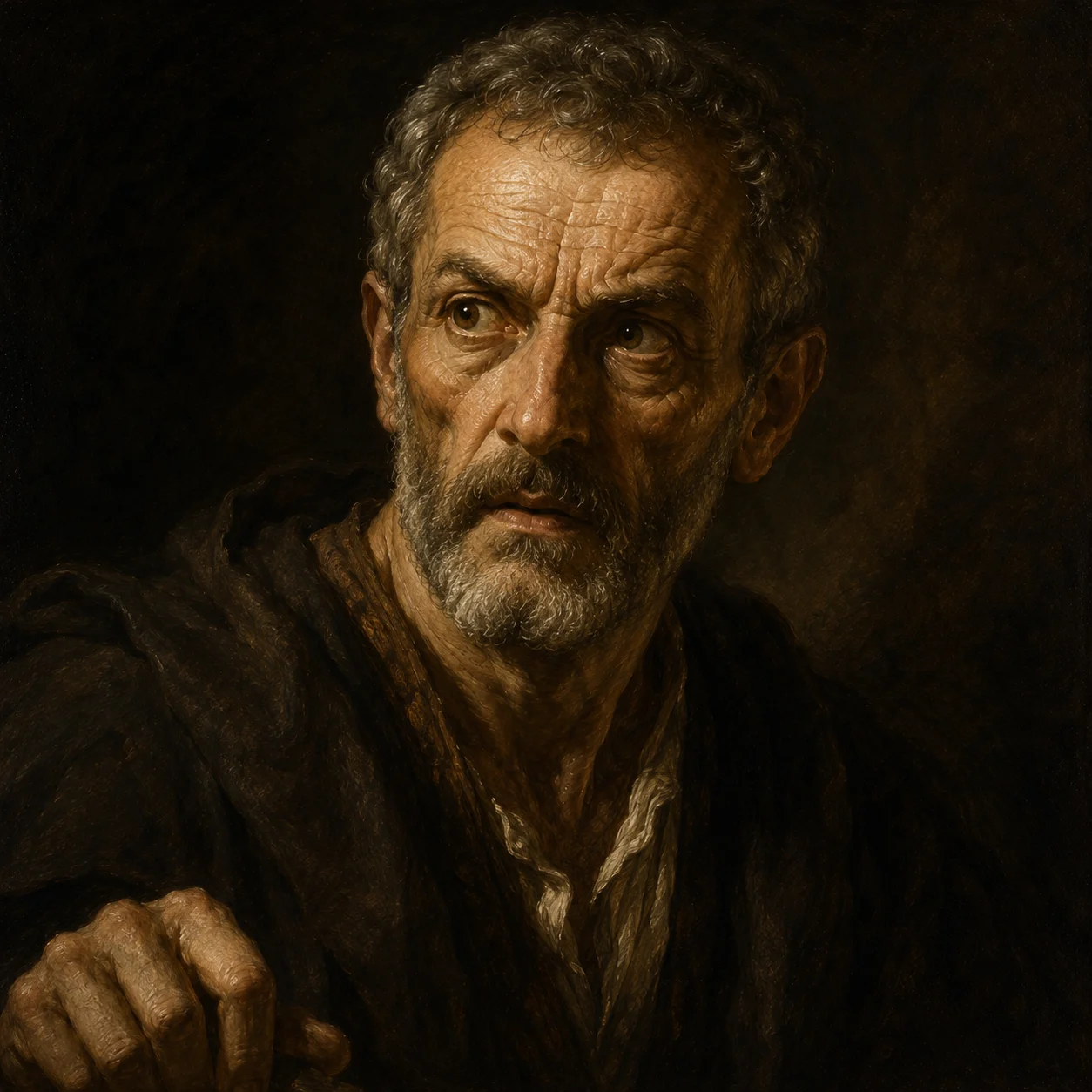
Artemidorus
Artemidorus functions as the play's clearest dramatic irony device - the audience knows, through him, exactly what is about to happen and exactly who is responsible, and then watches Caesar dismiss him without reading the letter. His two scenes compress the gap between knowledge and power into its most acute form.
Appears In
Who is Artemidorus?
Artemidorus is a teacher of rhetoric who, somehow, knows the names of every conspirator and has written Caesar a letter listing them: 'Caesar, beware of Brutus; take heed of Cassius; come not near Casca; have an eye to Cinna; trust not Trebonius; mark well Metellus Cimber; Decius Brutus loves thee not; thou hast wronged Caius Ligarius.' The letter is accurate, complete, and arrives too late to matter.
He appears alone in Act II Scene 3, reading his letter aloud - the audience hears exactly what Caesar will not - and then again in Act III Scene 1, pressing his way through the crowd toward Caesar as the procession moves to the Capitol. He calls out repeatedly, begging Caesar to read his suit first, telling him directly that it 'touches Caesar nearer' than any other petition. Caesar, applying precisely the principle that kills him - that he must not appear to attend to personal matters before public ones - waves him aside.
Artemidorus disappears from the play the moment Caesar enters the Capitol. He had the information, the nerve, and the position, and it still was not enough. He is the play's most concentrated image of dramatic irony: the man who knows everything watching the thing he knows happen anyway.
Motivation
Artemidorus appears to be motivated by genuine loyalty to Caesar and a belief that his information, if delivered, will save him. How he came to know the conspirators' names is unexplained - the play treats his knowledge as simply given, which heightens rather than undermines his function.
Personality
Artemidorus has the rarest quality in the play: complete, correct information about what is about to happen. He is not hesitant or ambiguous - his letter is specific, his pursuit of Caesar is urgent, his need to be heard is evident. The tragedy of his scenes is that none of these qualities are enough against a man who cannot afford to seem to read his own name first.