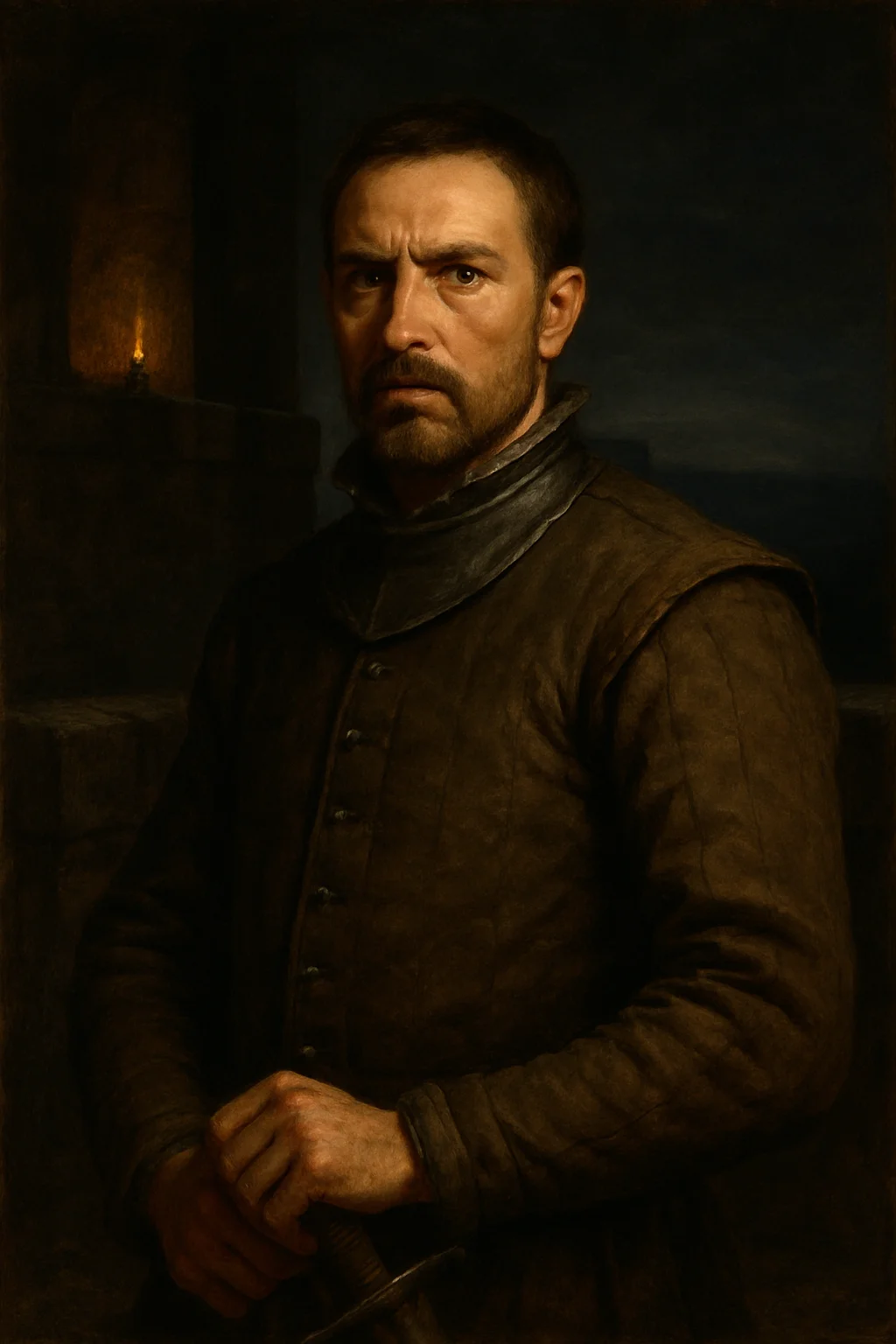
Marcellus
Marcellus is the practical intelligence of the opening act - the man who thinks to fetch Horatio, who names the corruption in the state with unadorned directness, and who swears the oath that seals the play's first conspiracy of knowledge. He is the bridge between the supernatural encounter on the battlements and the court intrigue that follows.
Appears In
Who is Marcellus?
Marcellus is an officer of the watch at Elsinore - one of the two soldiers who first encounters the Ghost and, crucially, the one who insists on bringing Horatio to confirm what he and Bernardo have seen. His instinct to summon a scholar rather than act on his own terror is the move that sets the entire play in motion: without Marcellus, Horatio never sees the Ghost, and Hamlet is never told.
He is present through the whole of the Ghost's first appearances - Act I Scenes 1, 4, and 5 - and speaks with a directness and moral clarity that distinguishes him from a mere attendant. It is Marcellus who delivers what may be the most quoted line in English after 'To be or not to be': 'Something is rotten in the state of Denmark.' He says it simply, as an observation, not a speech - and its plainness gives it more weight than any rhetorical flourish could.
After Act I, Marcellus disappears entirely. He is sworn to secrecy by Hamlet, and the play lets him keep that oath in silence. His significance is concentrated entirely into the opening act, where he functions as the common soldier's voice of instinct and plain truth in a court that will spend the rest of the play suppressing both.
Motivation
Marcellus is motivated by a duty of honesty to Prince Hamlet and a clear-eyed recognition that what he has witnessed matters beyond his own understanding. He does not overinterpret what he sees; he simply ensures that the right people know about it.
Personality
Marcellus speaks plainly and acts sensibly in situations that unmoor most people. His most famous line - 'Something is rotten in the state of Denmark' - is characteristic: no flourish, no qualification, just the blunt truth of a man who observes clearly. His willingness to swear the oath of silence shows both loyalty to Hamlet and the discipline of a soldier who understands when to speak and when to stop.