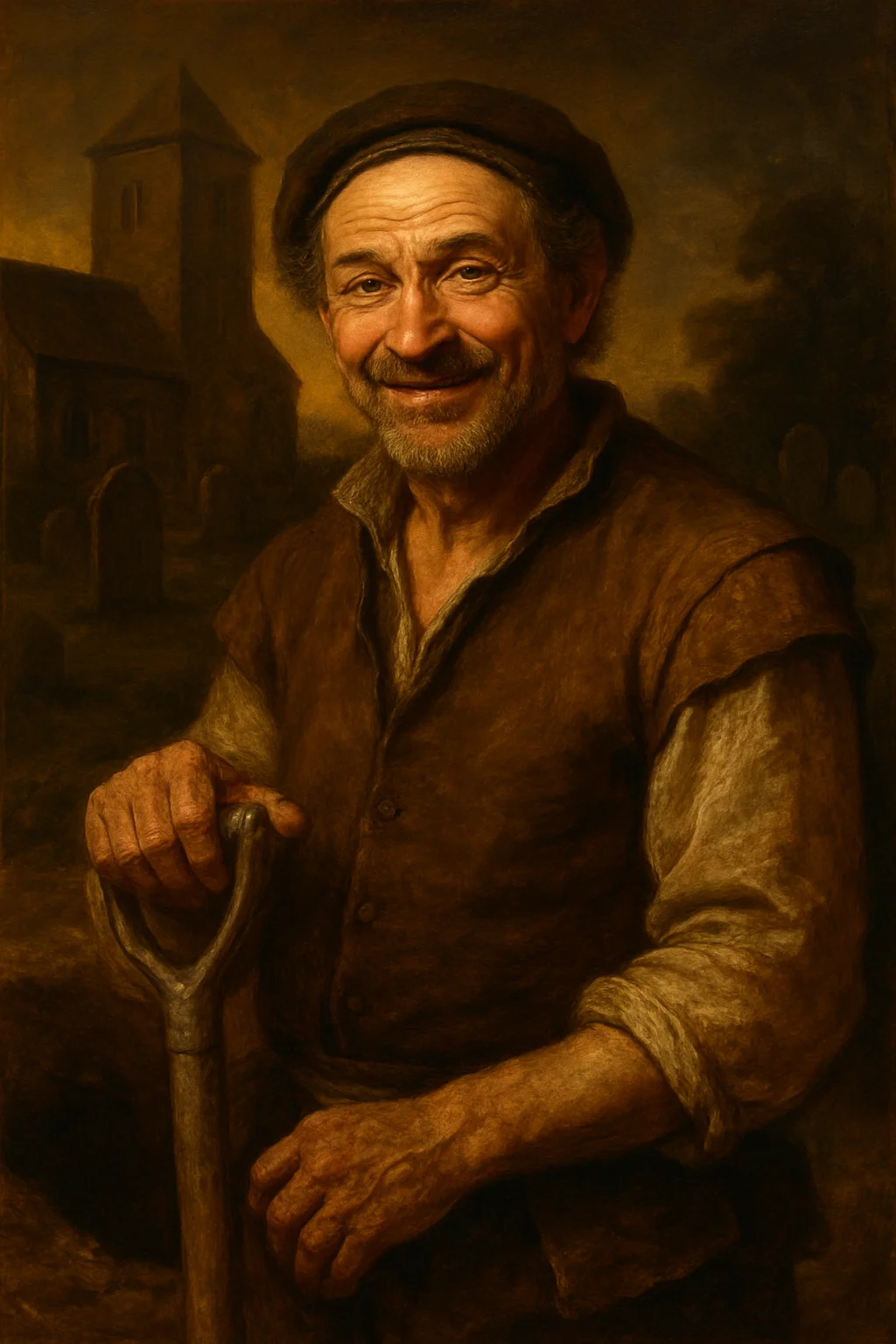
Gravedigger
The Gravedigger is the play's great democratic philosopher - a working man who knows more about death than anyone else in Elsinore precisely because he deals with it practically rather than abstractly. His scene with Hamlet is the play's tonal shift from action toward acceptance, the moment where the tragedy begins to find its resolution.
Appears In
Who is Gravedigger?
The Gravedigger - named in the Folger text simply as 'Gravedigger,' though traditional productions often call him the First Clown - is a working man digging Ophelia's grave in Act V Scene 1 when Hamlet and Horatio arrive. He is one of Shakespeare's great comic figures, a man of robust common sense and dark professional philosophy whose wit more than holds its own against the prince's.
His exchange with Hamlet about the skulls he has been unearthing - a conversation that culminates in the skull of Yorick, the court jester whom Hamlet loved as a child - is one of the most celebrated passages in all of Shakespeare. The Gravedigger handles death as a tradesman handles his materials, without ceremony and without fear, and his matter-of-fact relationship with mortality is both funnier and more confronting than all of Hamlet's formal meditations on the subject.
The scene turns on a reversal: Hamlet has spent four acts thinking about death, and he is less comfortable with it than the man who digs graves for a living. The Gravedigger's riddles, his cheerful inexactness about dates, his proprietary attitude toward his skulls - 'Here's a skull now; this skull hath lain in the earth three-and-twenty years' - constitute an education in mortality that Hamlet's philosophy has not quite managed to provide.
Motivation
The Gravedigger is motivated by nothing more complicated than doing his job well and enjoying a good argument. He is not impressed by princes, does not fear death, and has opinions on everything - from the law of suicide to the social hierarchy of corpses.
Personality
The Gravedigger is the play's sanest character - a man who has made his peace with mortality through daily acquaintance rather than philosophical labor. His dark humor is not morbidity but professional ease: he has been digging graves since the day Hamlet was born and expects to keep doing so. His wit is genuine, his logic sharp, and his refusal to be awed by rank is entirely consistent.